Slate lies at Snowdonia’s core. Its extraction dates back to Roman times, however Welsh slate production thrived in the late 18th century, marking its golden age. Demand soared and dominated Snowdonia for 150 years, reshaping North Wales’s landscape forever…
The four key quarrying regions; Bethesda, Llanberis, Nantlle and Blaenau Ffestiniog, yielded some of the world’s finest slate.
During the Industrial Revolution, Welsh slate became vital worldwide. Dinorwig and Penrhyn mines, each employing over 3,000 workers, led global production. Narrow-gauge railways linked them to new ports at Porthmadog and Porth Penrhyn for export.
During the Industrial Revolution, Welsh slate became indispensable across Britain, Europe, and North America. Mines expanded rapidly to meet demand; Dinorwig and Penrhyn emerged as the world’s largest slate mines, each employing over 3,000 workers. Narrow-gauge railways were constructed to ferry slate to new ports at Porthmadog and Porth Penrhyn for export.
By the late 19th century, slate quarries were prominent and has a significant environmental impact. Accumulating slate waist dominated valleys. New towns and villages emerged to accommodate the growing workforce; at its peak, over 17,000 men produced 485,000 tons of slate annually.
Many of the network of paths created to link the small villages and hamlets to the quarries, schools and chapels and the surrounding countryside are still in use today. As well as spectacular views, the slate paths provide a glimpse into the life and work of the quarrymen with walks through slate tips, quarry buildings, quarrymen’s barracks, and railways.
No visitor to Blaenau Ffestiniog, a small town in the heart of the Snowdonia National Park, can escape its slate mining past. The piles of waste slate still dominate the hillsides above ‘the town that roofed the world.’
A trip to Zip World Llechwedd lets modern-day visitors tour over the slate-covered hillsides and open caverns, or head 500 feet underground via the steepest cable railway in Britain to learn about miners’ lives on their historic Deep Mine Tour.
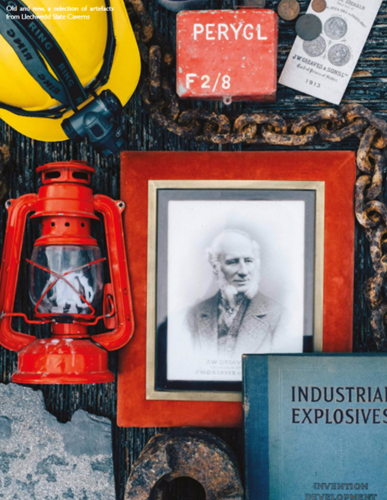
The mine was opened by John Whitehead Greaves in 1846 who was convinced there was a huge amount of slate to be found at Llechwedd. In 1849 he discovered the Merioneth OldVein. His slate won a prize medal at the Great Exhibition of 1851 and orders flowed in, including contract to supply Kensington Palace.
Slate was extracted from the mine, brought to the surface, split (a process that is still done by hand today) and then dressed – trimmed to size. It would then be packed into where it would be loaded onto small Liverpool-bound schooners before being shipped off around the world. However for every one part of slate exported nine parts were wasted and this literal waste land has become an adventurous attraction.
At it’s peak, there were 19 working mines in Blaenau Ffestiniog. At Llechwedd alone there are 250 chambers, 16 working levels and 25 miles of tunnel connecting them. Find out more by taking a trip back in time to Llechwedd.
